158891
Book
In basket
(Studia i Monografie / Politechnika Opolska, ISSN 1429-6063 ; z. 594)
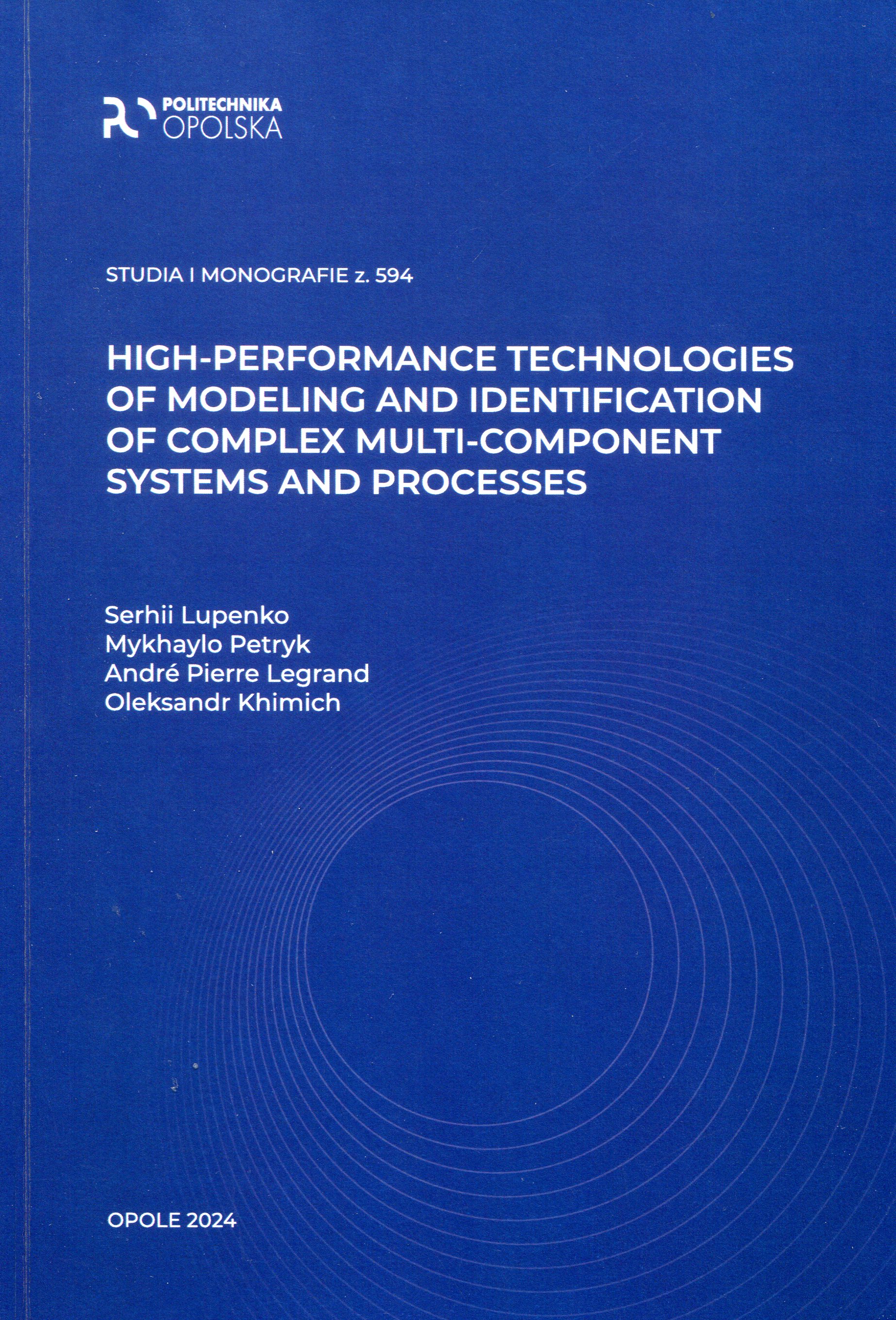
STOCHASTIC MODELSAND RHYTHM-ADAPTIVE INFORMATION TECHNOLOGY OF BIOMEDICAL CYCLIC SIGNALS PROBABILITY STRUCTURE IDENTIFICATION 1.1.Model-based, data-driving and the hybrid paradigms identification of the probability structure of cyclic biomedical signals 1.2.Cyclic random process and cyclically correlated random process 1.3.Vector of cyclically correlated rhythmically connected random processes and vector of cyclic rhythmically connected random processes 1.4.Rhythm-adaptive methods of statistical processing of a cyclic random process and a vector of cyclic rhythmically connected random processes 1.5.Estimation of the rhythm function of cyclic stochastic signals 1.6.Rhythm-adaptive discretization of a cyclic random process 1.7.Rhythm-adaptive technology of spectral analysis of one-dimensional probabilistic characteristics of cyclic signals with a variable rhythm RHYTHM-ADAPTIVE TECHNOLOGIES OF ECG CHARACTERISTICS IDENTIFICATION IN BIOMETRIC AUTHENTICATION AND CARDIOVASCULAR DIAGNOSTIC SYSTEMS 2.1.A general approach to building information technologies for biometric authentication and medical diagnostics based on ECG 2.2.Advantages of rhythm-adaptive technologies for identification of ECG signals over nonrhythm-adaptive ones 2.3.Person authentication technology based on rhythm-adaptive processing of the ECG signals 2.4.Technology of medical diagnosis of arrhythmias based on rhythm-adaptive processing of the ECG signals CHAPTER 1.RHYTHM-ADAPTIVE TECHNOLOGIES OF EEG CHARACTERISTICS IDENTIFICATION IN NON-INVASIVE BRAIN-COMPUTER INTERFACES 3.1.A general approach to building non-invasive Brain-Computer Interfaces 3.2.Mathematical model andmethods of processing EEG signals in BCI systems 3.3.Results of studies of statistical characteristics of vector EEG MULTI-SENSOR ANALYSIS OF COGNITIVE SIGNALS FOR NEUROLOGICAL DISORDERS AND DISEASES 4.1.Development Methodology multi-sensor analysis of cognitive signals of abnormal neurological movement 4.2.The digital ANM trajectory of a patient's limb movement 4.3.Hybrid mathematical model for the analysis of the ANM of the tremor-object based on feedback of cognitive signals of EEG multisensors of the neural nodes of the core cerebral 4.4.The matrix algorithm for the ANM adaptive coefficients identification 4.5.Computational analysis of ANM and the cerebral cortex signals 4.6.Methodology for creation of analytical solution of Hybrid mathematical model ANM based on feedback of cognitive signals of EEG multisensors of the neural nodes of the core cerebral (detailed description] 4.7.Identification methodology of ANM amplitude components. Inverse heterogeneous boundary value problem taking into account the cognitive feedback-influences of the neuro-nodes of the CC (micro level] 4.8.Spatial visualization of the results of digital analysis of the ANM trajectory of the T-object 4.9.Modeling and identification of parameters of complex multicomponent convective feedback systems on multicore computers (micro level] THE MATHEMATICAL METHODOLOGY OF MATRIX HYBRID INTEGRAL TRANSFORMATIONS FOURIER FOR CREATION OFANM-MODELS 5.1.Finite integral Fourier transformations with spectral parameter for soft homogeneous media 5.2.Matrix finite hybrid integral Fourier transformations for limited heterogeneous n-component media CHAPTER 6. A MATHEMATICAL METHODOLOGY OF MATRIX FINITE HYBRID INTEGRAL TRANSFORMATION FOR HETEROGENEOUS N-COMPONENT CYLINDRICAL MEDIA 6.1.A matrix finite hybrid integral transformation of the Hankel type of the second kind for limited heterogeneous n-component cylindrical media 6.2.A matrix finite hybrid integral transformation of the Fourier - Bessel for unlimited heterogeneousn-component cylindrical media MATHEMATICAL MODELING OF COMPETITIVE ADSORPTION AND DESORPTION OF GASES IN NANOPOROUS MEDIA USING LANGMUIR’S EQUILIBRIUMS 7.1.Analysis of complex co-adsorption systems and processes in nanoporous media to solve the reducing of carbon emissions into the atmosphere and solving of the global warming problems 7.2.Physical justification of the problem with the use of NMR analysis results 7.3.A mathematical model of competitive co-adsorption in microporous solids 7.4.Mathematical model of nonisothermal adsorption and desorption systems in a nanoporeus partiles media 7.5.The scheme of nonlinear model linearization and construction of a linearized problems system solution METHODS AND HIGH-PERFORMANCE TECHNOLOGIES OF MODELING AND IDENTIFICATION OF COMPLEX MULTI-COMPONENT SYSTEMS AND PROCESSES 8.1.High-performance computing for incorrect problems 8.1.1Modern paradigms of mathematical modeling 8.2.Three-stage method of regularization for ill-posed problems 8.3.Solving SLAE with a symmetric positive semidefinite sparse matrix
Media files:
Availability:
Wypożyczalnia
There are copies available to loan: sygn. 157381 N, 157382 N, 157383 N (3 egz.)
Notes:
Bibliography, etc. note
Bibliografia na stronach 193-202.
The item has been added to the basket. If you don't know what the basket is for, click here for details.
Do not show it again

Accessibility declaration